


Composting & No-Till Gardening

First off, Becky recommends the regenerative soil and permaculture expert, Matt Powers; you can check out his channel on YouTube. She also recommends Ben Faulk, author of The Resilient Farm and Homestead.
Composting
There are many different methods and setups for composting. Becky and I covered a few different ones at this class. If you have livestock, simply mixing manure and straw/bedding and letting it sit for a year, can be a form of composting. Turning the pile every so often can help speed up the process.
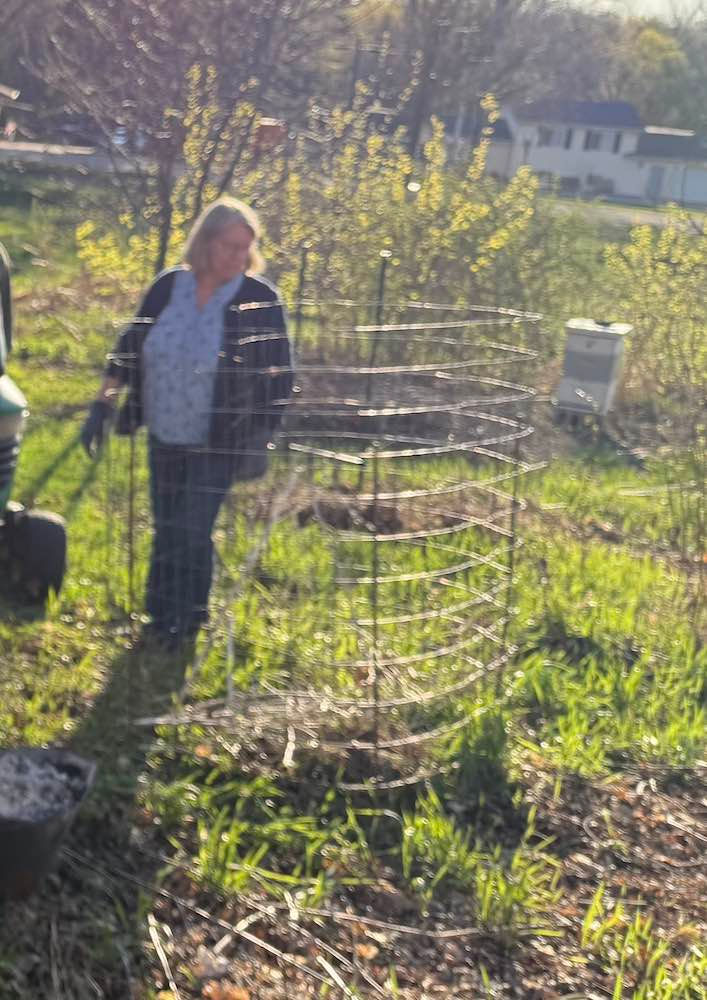
Another simple setup Becky showed us involved bending welded wire into a ring. Into this, you can add layers of nitrogen and carbon. Examples of nitr

ogen (or greens) include kitchen scraps (fruit and vegetable peels, skins, cores, and other bits), grass clippings, and livestock manure or even rabbit pellets from your yard if you don't have. Coffee grounds and egg shells (broken or ground up) are also excellent additions to a compost pile. Carbons (or browns) include dead leaves or straw, wood chips (but not Black Walnut which inhibits the growth of plants), plain brown paper or cardboard, stems, twigs and branches, and untreated sawdust. You can also add small amounts of wood ash (less than 5% of the total volume of the pile). Layer or mix your sources of nitrogen and carbon. Becky recommends 4 parts carbon to 1 part nitrogen. Having boys pee on a compost pile can also add nitrogen and speed up the decomposition process. Again, after a year, the pile should be completely composted. Turning the pile will speed up the process.
How often should you turn the pile? Ideal turning frequency will depend on many factors such as temperature, moisture level, and size and contents of the pile. In some cases, you may need to turn it every few days to reach optimal decomposition. Checking the temperature is a good way to measure when it is time to turn the pile. Becky uses a long compost thermometer to do this. Around 140 degrees indicates good activity within the pile. If you reach 160, it is time to turn it before it gets too hot (when the microbes may be running out of oxygen). Turning the pile will introduce fresh oxygen, revive beneficial microbes, and ensure the whole pile reaches a desired temperature to kill weed seeds and pathogens. If optimal decomposition happens, your compost may be ready in about 8 weeks.
If your pile is not producing heat, it may be too dry and you'll want to add water. You can cover a pile with burlap bags to help retain moisture. A perforated tube placed in the middle of a compost pile can also help with aeration of the pile, especially is the more dense middle.

Becky recommends locating your compost pile close to where you want to use it. Spring is a good time to add compost to your garden/soil. If you have chickens, they will help spread out your compost.
Worm composting is another easy composting method that can be done indoors. With worm composting, turning the pile is not necessary, as the composting worms (Red Wigglers) do that work for you. Teresa recommends reading Laverme's Handbook of Indoor Worm Composting by Ellen Sandback to learn more.
No-Till Gardening

Broadforks
Using a broadfork is a good method to uproot grass and start an area for a new bed. It loosens soil, but doesn't disturb the underlying soil structure. She recommends broadforks by Meadow Creature. After broadforking, it becomes easy to pull up weeds and water can get further down into the soil.

Hulgelkultur
This is a method of gardening where you build a mound using rotting wood for the base, sticks and branches as fill, and compost on top. You can plant into the mound, and as the wood breaks down, it will feed plants for many years. The wood will also help retain moisture in the mound. Here's a YouTube video by Epic Gardening for learning more about Hugelkultur.
Cover Cropping
Cover cropping is another great way to support no-till gardening. Becky recommends buckwheat and oats as good cover crops. "The primary function of a cover crop is to protect the soil surface, but in addition, it can provide your soil environment rest, nutrition, aeration, or “exercise” – or a combination of those benefits." You can learn more from cover-cropping expert Jack Algiere on this page of the Joe Gardener show website.
A big thank you to Becky Bravinder for teaching this great class!


Comments